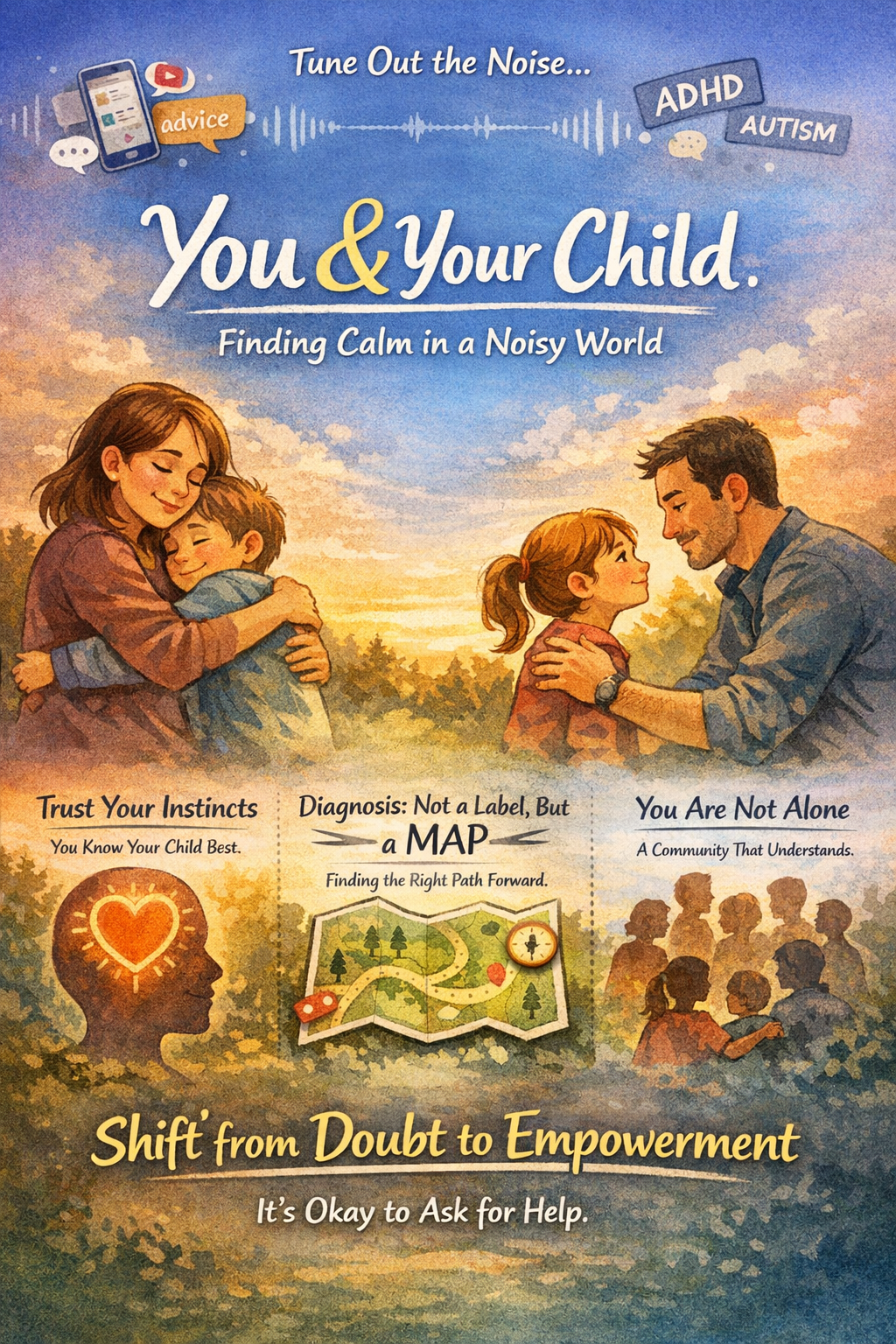
1. You Are the Expert, Not the Problem
First, let’s clear the air: Your child’s struggles are not a reflection of your parenting. Whether it is ADHD, Autism, or a “High-Need” personality, these are neurological and temperamental blueprints. You didn’t cause them, and you can’t simply “discipline” them away.
-
The Positive: You are here because you care. That intuition—the “gut feeling” that something is different—is your greatest parenting tool. Trust it.
2. ADHD, Autism, or “High-Need”?
It’s easy to get lost in the “Why.”
-
High-Need: Some children simply have a “larger” nervous system. They feel more, cry louder, and need more proximity.
-
Neurodiversity (ADHD/Autism): This is about how the brain processes information, focus, and social cues.
The Reality: The “label” isn’t a box that traps your child; it’s a map. If you are lost in a forest, having a map doesn’t change the forest, but it tells you where the paths are. A diagnosis is just a map to help you stop wandering and start walking toward the right support.
3. Shifting the Perspective: From “Label” to “Key”
Many parents avoid psychological help because they fear the stigma. But think of it this way:
-
Without a diagnosis: We often blame the child (“Why won’t they just listen?”) or ourselves (“What am I doing wrong?”). This leads to resentment and exhaustion.
-
With a diagnosis/professional help: We blame the condition, not the person. We can say, “Their brain is struggling with transitions right now,” instead of “They are being defiant.”
Empathy Note: It is okay to grieve the “easier” path you thought you’d have. It is okay to feel tired. Seeking a professional isn’t “giving up”—it’s bringing in a consultant for the most important project of your life.
4. You Are Not Alone
The “loneliness” of parenting a complex child is real. You see other parents at the park sitting on benches while you are constantly “on,” managing a potential meltdown or redirecting energy.
-
The Truth: Thousands of parents are feeling exactly what you feel right now.
-
The Reassurance: Your child has incredible strengths. Neurodivergent and high-need children are often the most creative, empathetic, and out-of-the-box thinkers. Seeking help is how you unlock those strengths while managing the challenges.